
Think you know what cruising is really like? Some of the biggest “facts” about cruise holidays simply aren’t true.
From endless buffets to being trapped at sea with nothing to do, cruise myths have a habit of sticking around. And while some are easy to spot, others sound convincing enough to fool even experienced cruisers.
A few might even be putting people off cruising for no good reason.
So, which cruise myths are complete nonsense – and which ones have a surprising amount of truth behind them?
MYTH: Cruise ships are the cause of over-tourism
REALITY: Cruise passengers represent just 2% of tourists in the world. Even in a sensitive location like Venice, cruise passengers make up only 5% of visitors.
The cruise industry recognises the importance of tacking destination overcrowding and works closely with communities in key locations to address their concerns.

MYTH: Cruise ships are breeding grounds for gastro-intestinal diseases
REALITY: Illnesses like norovirus are much more common on land than on-board cruise ships.
Despite its reputation as the “cruise ship virus”, norovirus is far more commonly associated with outbreaks on land. According to the CDC, cruise ships account for only around 1% of all reported norovirus outbreaks.
Cruise ships also have strict procedures in place to reduce the risk of illness spreading. Some cruise lines may screen passengers for signs of illness before boarding and ask those who have recently experienced symptoms to report them.
Once on board, passengers are encouraged to wash their hands regularly, while crew follow detailed cleaning and sanitation procedures. If cases of gastrointestinal illness are detected, cruise lines can introduce additional measures to help prevent an outbreak from spreading.
Read more: Cruise ship norovirus: Vital information to avoid illness
MYTH: Cruise ships operate outside the law once they’re in international waters
REALITY: Cruise ships are highly regulated, even when at sea. They are covered by local, national and international laws wherever they sail.
Cruise ships up to 12 nautical miles from the coast are with a country’s territorial waters and almost all of the laws of that country will apply.
Ships between 12 and 24 nautical miles from the coast are within a country’s contiguous zone and that country has certain rights.
Ships more than 24 nautical miles from the coast are considered to be in international waters and are covered by the laws of their flag state (where the ship was registered, which is often the Bahamas).
Cruise lines voluntarily report any serious crime allegation on oceangoing voyages worldwide, regardless of the ship’s location and flag.
Suggested read: What Can You Get Away With in International Waters?
MYTH: Cruise ships are crime hotspots
REALITY: Serious crimes can happen on cruise ships, but reported incidents are relatively uncommon considering the millions of people who cruise each year.
Cruise ships have extensive security measures in place, including CCTV, security teams and controlled access to the ship.
In the US, the Cruise Vessel Security and Safety Act requires certain alleged crimes and missing-person incidents on applicable cruise ships to be reported to the FBI. The US Department of Transportation publishes this data in its Cruise Line Incident Reports, with figures broken down by cruise line and type of incident.
Take a look at the security centre on board a cruise ship…
Read more: How Safe Are Cruise Ships Really?
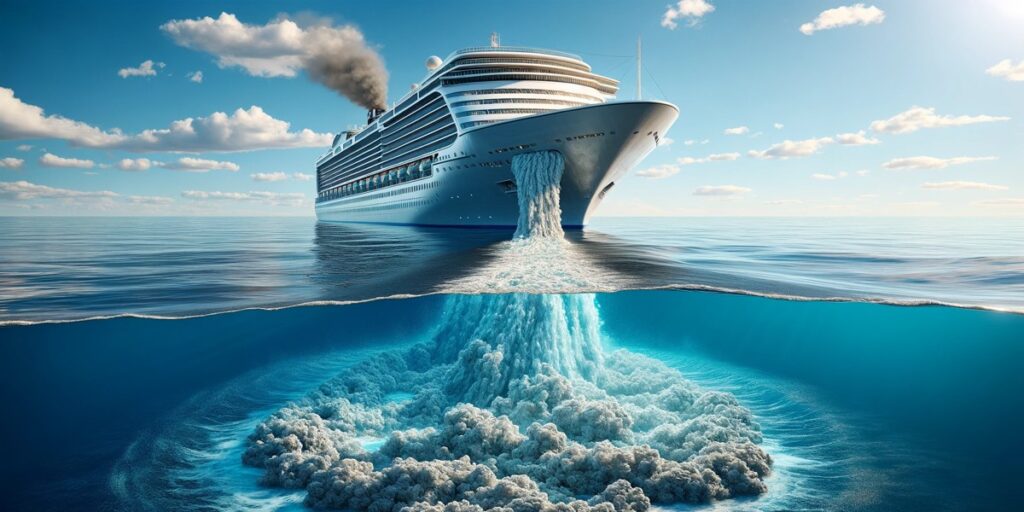
MYTH: Cruise ships release untreated sewage into the ocean
REALITY: Cruise ships have strict rules governing how sewage and wastewater can be discharged at sea.
Modern cruise ships have onboard wastewater treatment systems designed to treat sewage before it is discharged. However, international MARPOL regulations do allow untreated sewage to be discharged in certain circumstances, including when a ship is more than 12 nautical miles from the nearest land and specific conditions are met.
So, while cruise ships can legally discharge sewage at sea, they can’t simply dump untreated waste wherever they like.
Read more: What Cruise Ships Do With Sewage
MYTH: Cruise ships are really bad for the environment
REALITY: Cruise ships do have an environmental impact, but the industry is investing heavily in ways to reduce it.
Modern cruise ships are increasingly using technologies designed to cut emissions, improve energy efficiency and reduce waste. These include more efficient engines and hull designs, shore power systems that allow ships to switch off their engines while in port, and advanced systems for treating wastewater and managing waste on board.
Members of Cruise Lines International Association (CLIA) have committed to reducing the rate of carbon emissions by 40% by 2030, compared with 2008 levels. CLIA member cruise lines are also pursuing net-zero emissions by 2050.
Waste is another area where cruise lines are making changes. Ships have extensive systems for sorting, recycling and processing waste produced on board, while strict international regulations govern what can be discharged at sea.
There’s still a long way to go, and cruising certainly isn’t impact-free. But newer ships and technologies are changing how cruise lines tackle their environmental footprint.
This video shows some of the environmental technologies and practices being introduced on cruise ships:
MYTH: People going overboard on cruise ships is becoming more common
REALITY: People do go overboard from cruise ships, but these incidents are extremely rare compared with the millions of people who cruise each year.
According to CLIA’s State of the Cruise Industry Report, 34.6 million people took an ocean cruise in 2024.
In comparison, Cruise Radio documented 19 overboard incidents in 2024 across the cruise industry. This figure includes both passengers and crew members and isn’t an official global statistic, but it helps put the rarity of these incidents into perspective.
Cruise ship railings are specifically designed to help prevent accidental falls, and simply falling overboard during normal use of the ship is extremely unlikely.
Suggested read: What Happens If You Jump Off A Cruise Ship?
MYTH: Cruise ships don’t always have enough lifeboats for everyone
REALITY: By law, every cruise ship must be equipped with enough survival craft to accommodate at least 125% of the number of people on-board
All cruise lifeboats are tested to meet rigorous international guidelines. Cruise ships must also carry enough lifejackets for everyone on-board, although in reality, they usually have many more than are legally required.
The idea that ships aren’t safe is just one of those myths about cruising that’s hung around as a scare story.
Ever since the Titanic disaster, safety standards were completely overhauled.
Final Word
Cruising is quite different from most other types of holiday, so perhaps it’s no surprise that a few myths have stuck around.
Of course, cruise ships aren’t perfect. Illness, crime and accidents can happen, and the environmental impact of cruising shouldn’t be ignored. But some of the claims you hear about cruise holidays are exaggerated, outdated or simply missing important context.
If one of these myths has been putting you off booking a cruise, hopefully you now have a clearer picture of what life at sea is actually like.

I’m sorry, but you are not correct in many of your claims. Cruise ships are environmental hooligans causing immeasurable damage to ecosystems and producing staggering amounts of pollution. Sadly the picture you paint is a false one. I understand this is your livelihood but please consider a new career.
Hi Glenda. Thank you for your comment. I want you to know that the environment is of huge importance to me. I drive an electric car and eat a vegan diet so that I can minimise my own carbon footprint. Of course, it would be more sustainable for me to stay at home and never take a cruise. But we have to have a balance. I believe that with the changes that the cruise industry is making, including many cruise lines such as MSC and Virgin Voyages becoming carbon neutral, that cruising provides one of the best options currently, and that will only improve as innovations are made. Jenni
I am a single traveller I never feel alone on a cruise ship and mix well great holidays and meet interesting people.
I know a lot of ladies share but 2 men sharing can some times send the wrong signals.
However the old single supplement charge any tips?
I tend to book early 10/ 12 months in advance. Trying Anthem of the Sea single Studio cabin next May 2022. They advertise no single supplement but you pay more for the cabin grade.
Some times the single supplement can be nearly as much if paying for 2 persons.
Hi Trevor. I have some tips for solo travellers here: https://www.cruisemummy.co.uk/po-cruises-single-supplement/ While the article is about P&O Cruises, a lot of the info is relevant to other cruise lines too. I hope this helps. Jenni
We’ve been cruising for the last 8 years, always from Southampton. We made the decision last year to book a fly cruise from Malta. Due to COVID we moved this cruise to next May 22.
Any tips for our first fly-cruise?
Thanks
Hi Rachael. Great question. I would say 1. Make sure you book it as an ATOL-protected package holiday so that you’re covered if any part of it fails. 2. Fly to Malta at least one day before you cruise so that you don’t miss it. 3. Consider adding on a hotel stay for a few days to make the most of your time in Malta. A good travel agent can make a tailor-made package for you. Let me know if you’d like a recommendation! Thanks! Jenni
Hi,
Already booked and going on my first MSC cruise in July ’21. (After reading report on the “Magnifica” in Trip Advisor not sure if I’ve made the right decision.) Yes you’re right I should have thoroughly researched this trip first but both Cruise Circle and Planet Cruise were offering very good Solo prices for this Norweigan Fiord cruise Dpt 10th July from Southhampton. I am not on any drinks package as I am not a great drinker however I have seen their drink prices but nowhere can I see that 15% is added as an additional charge. (Read this also in Trip Advisor). May also buy a bottle or two of wine to consume in the non premium restaurant.
Question – Would slacks and smart polo shirts be acceptable in the restaurant for dinner? All MSC talk about is DJ’s and Suits. I am an OAP but that should make no difference eh?
Many thanks in anticipation,
.
Hi John. That sounds like a wonderful cruise! MSC Cruises have casual evenings and formal evenings. If you wish to dine in the main dining room on a formal evening it’s suggested that you wear a suit and tie, but in reality, a nice collared shirt would be more than acceptable. On a casual evening, you can wear whatever you like. I hope this helps. Jenni