A pregnant cruiser was medically evacuated by the US Coast Guard just hours after Carnival Sunrise departed from PortMiami on 16th July 2026. This occurred following the onset of serious pregnancy complications. The 29-year-old woman was safely transported to shore and taken to a Miami Beach hospital whilst the ship continued its scheduled Bahamas itinerary.

The US Coast Guard Station Miami Beach dispatched a rescue boat crew after receiving an urgent request from Carnival Sunrise’s security manager. This request was made approximately four miles northeast of Government Cut, the main shipping channel connecting PortMiami to the Atlantic Ocean. The vessel had departed at around 3:30 p.m. EDT, meaning the medical emergency developed within hours of embarkation.
“A Coast Guard Station Miami Beach boat crew medically evacuated a 29 year old woman experiencing pregnancy complications from a cruise ship approximately 4 miles northeast of Government Cut on Thursday,” the US Coast Guard Southeast confirmed via Facebook.
“The rescue began after Sector Miami watchstanders received a report from the vessel’s security manager requesting Coast Guard assistance.”
The proximity to port allowed for a swift response, with rescuers able to reach the 101,509-gross ton vessel quickly. They transferred the passenger to their rescue boat. The location of the emergency, just miles from Miami’s coastline, proved fortunate for the expectant mother who required urgent medical attention.
Swift Transfer to Mount Sinai Medical Centre Miami Beach
Following the successful evacuation from Carnival Sunrise, Coast Guard personnel transported the woman directly to shore. Emergency medical services were standing by. An ambulance was waiting to receive the patient and immediately transported her to Mount Sinai Medical Center in Miami Beach, a leading healthcare facility equipped to handle high-risk pregnancy complications.
The coordinated response between the cruise ship’s medical team, Coast Guard rescuers, and shore-side emergency services exemplified the well-established protocols that exist for maritime medical emergencies in South Florida waters.

Mount Sinai Medical Center, located in Miami Beach, is recognised for its comprehensive maternity services and emergency obstetric care capabilities.
No updates on the passenger’s condition have been publicly released. Carnival Cruise Line has not issued an official statement regarding the incident. The cruise line typically maintains passenger privacy in medical situations unless there are broader safety implications for other guests or significant operational impacts.
Carnival Sunrise Continues Bahamas Sailing Without Itinerary Changes
The medical evacuation did not disrupt Carnival Sunrise’s planned four-night voyage to the Bahamas. Cruise tracking data confirmed the vessel remained on schedule, proceeding towards Princess Cays and Nassau without reported itinerary modifications.
The 2,984-passenger ship was observed sailing calmly at approximately nine knots. This is consistent with normal cruising speed en route to Princess Cays, Carnival’s private destination in the Bahamas.
The relatively brief delay associated with the Coast Guard transfer did not necessitate any adjustments to port calls or scheduled arrival times.
Carnival Sunrise, which underwent a significant refurbishment in 2019 as part of the line’s fleet modernisation programme, operates year-round short cruises from PortMiami. The ship’s four-night and five-night Bahamas itineraries are popular choices for guests seeking quick getaways, often including first-time cruisers and families.
Understanding Carnival’s Pregnancy Policy and Safety Requirements
Carnival Cruise Line, like all major cruise operators, maintains stringent pregnancy policies designed to protect both expectant mothers and their unborn children. The cruise line prohibits women from sailing beyond their 24th week of pregnancy by the end of the cruise. This policy is actually more restrictive than most airline regulations.
“Pregnant women are welcome on board. Please note that for your own safety and the safety of your unborn child, you must not be beyond your 24th week of pregnancy by the end of the cruise to be allowed to sail,” Carnival’s official policy states.
“In every case you need a confirmation by your attending physician. Please ask us for the appropriate form.”
The 24-week cutoff is carefully calculated based on the limitations of shipboard medical facilities. Whilst cruise ships are equipped with medical centres staffed by qualified physicians and nurses, these facilities are designed primarily for urgent care and stabilisation rather than specialised obstetric services or neonatal care.
For context, most airlines permit domestic air travel until 36 weeks of pregnancy and international flights until between 28 and 32 weeks, depending on the carrier. The more conservative approach taken by cruise lines reflects the additional challenges of coordinating medical evacuations at sea compared to aircraft diversions.
Medical Documentation Required Before Embarkation for Expecting Mothers
Carnival enforces its pregnancy policy rigorously, requiring expectant mothers to obtain written confirmation from their attending physician that they are medically cleared to sail. The cruise line provides specific forms that must be completed by healthcare providers and submitted during the booking and check-in process.
During online check-in, all female passengers are asked whether they are pregnant as part of the health screening questions. This system ensures that pregnant guests are aware of the policy requirements. It provides an opportunity for the cruise line to verify compliance before embarkation day.
The requirement for physician approval acknowledges that pregnancy progresses differently for each woman and that individual health circumstances can vary significantly. A doctor’s assessment helps identify any risk factors that might make sea travel inadvisable, even within the 24-week window.
The 29-year-old passenger evacuated from Carnival Sunrise would necessarily have been within the allowable timeframe and obtained medical clearance to board, as enforcement of the policy at the gangway is standard procedure. However, pregnancy complications can arise unexpectedly, even in previously healthy pregnancies. This underscores why medical protocols and evacuation capabilities remain essential.
Strict Enforcement Demonstrated in Previous Boarding Denials
Carnival’s commitment to enforcing its pregnancy policy was notably demonstrated in 2024. A woman attempting to board Carnival Luminosa was denied embarkation after presenting at 26 weeks pregnant – two weeks beyond the permitted limit. This incident, reported by Cruise Hive, illustrated that the cruise line prioritises passenger safety over commercial considerations.
Such denials, whilst disappointing for the passengers involved, reflect the serious safety concerns that underpin the policy. Premature births carry significant risks, and complications requiring emergency delivery can quickly become life-threatening. This occurs without access to proper neonatal intensive care facilities and specialised obstetric equipment.
Cruise ship medical centres are typically staffed by general practitioners with emergency medicine training. They are supported by nurses with various specialisations. However, they lack the obstetric specialists, neonatologists, and sophisticated equipment found in hospital labour and delivery units.
Limitations of Shipboard Medical Facilities Compared to Shore Hospitals
The medical centres aboard cruise ships, including those operated by Carnival, serve an important function in providing emergency care. They treat common illnesses and injuries, and stabilise patients until they can be transferred to shore facilities. However, they are fundamentally different from land-based hospitals in scope and capability.
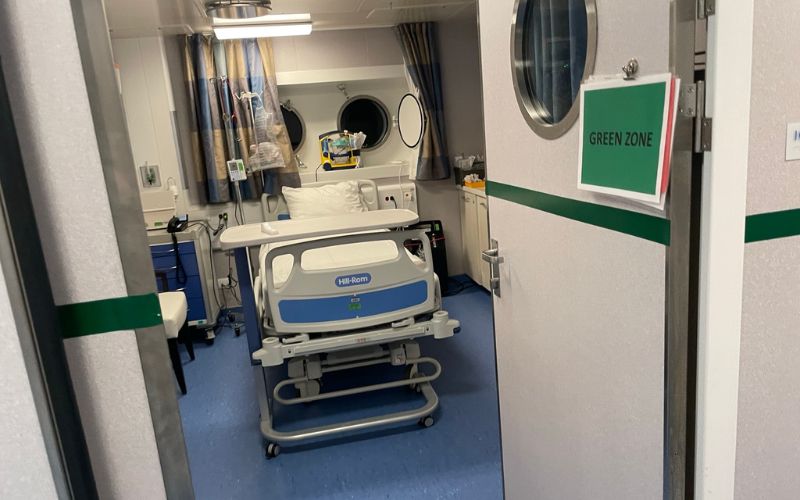
A typical cruise ship medical centre can handle a range of medical situations including cardiac emergencies, injuries, infections, and minor surgical procedures. Staff are trained to provide advanced life support and have access to diagnostic equipment. This includes X-ray machines, laboratory testing capabilities, and a pharmacy stocked with essential medications.
What these facilities cannot provide is the level of specialised care required for high-risk obstetric emergencies. This is particularly true for premature deliveries or complicated births. Neonatal intensive care units, essential for babies born prematurely, require highly specialised equipment. This includes incubators, ventilators, and monitoring systems that are simply not feasible to maintain aboard a moving vessel.
The limitations become even more pronounced when complications arise. Obstetric emergencies can require immediate access to operating theatres for caesarean sections and blood transfusion services. This requires teams of specialists including obstetricians, anaesthesiologists, and paediatricians – resources that exist only in comprehensive medical facilities ashore.
Broader Context of Medical Evacuations in the Cruise Industry
Medical evacuations from cruise ships are more common than many passengers realise. However, they represent a small fraction of the millions of cruise passengers who sail each year. The US Coast Guard alone conducts hundreds of medical evacuations annually from cruise ships operating in American waters. They respond to conditions ranging from heart attacks and strokes to traumatic injuries and pregnancy complications.
The cruise industry has invested significantly in medical capabilities and evacuation protocols over the past two decades. Advances in telemedicine allow shipboard doctors to consult with specialists ashore in real time. Improved communication systems enable faster coordination with coast guard services and port authorities when evacuations become necessary.
Geographic location plays a crucial role in evacuation logistics. Medical emergencies occurring close to port, as in this Carnival Sunrise incident, can be resolved relatively quickly with boat transfers. Situations arising in open ocean or remote areas may require helicopter evacuations. These are weather-dependent and logistically complex, or the ship diverting to the nearest suitable port.
The costs associated with medical evacuations can be substantial. They often run into tens of thousands of pounds when helicopter services or ship diversions are involved. This reality underscores the importance of comprehensive travel insurance that specifically covers medical emergencies and evacuations whilst cruising. Standard health insurance policies typically provide limited or no coverage outside one’s home country.
NEW DEALS JUST RELEASED!
See the latest Carnival cruise offers…