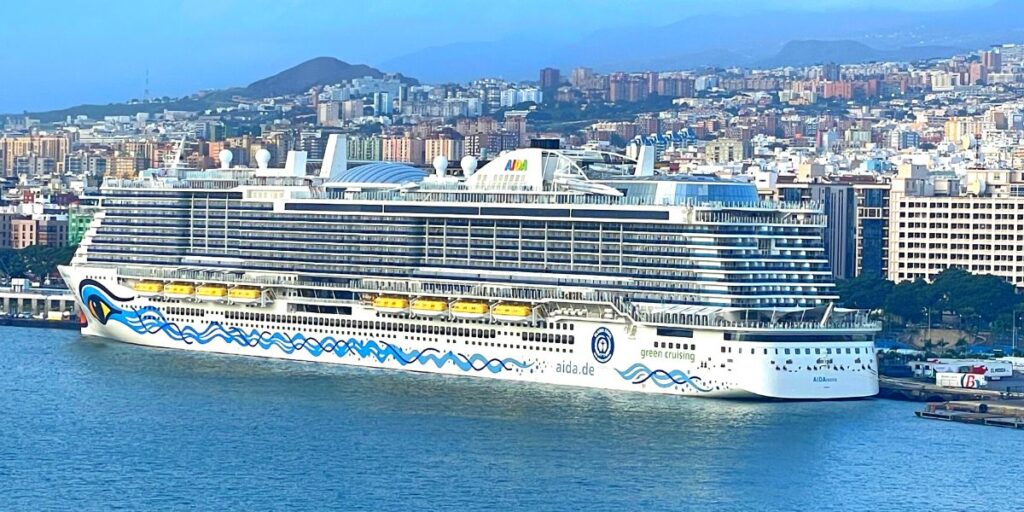
A German couple has launched legal action against AIDA Cruises seeking a substantial refund after discovering the nudist area aboard AIDAdiva had been dramatically reduced during their 128-day world cruise.
The passengers, who paid approximately €70,000 for the voyage, are demanding a 22% refund following the ship’s refurbishment that transformed the dedicated space into an exclusive suite-guest amenity.
Sabine Hartmann and Michael B. booked AIDAdiva’s world cruise in February 2024, relying on published deck plans that showed an extensive nudist area on Deck 14.
When the voyage departed from Hamburg on 10th November 2025, however, the couple discovered the space had been completely transformed.
The ship underwent a comprehensive refurbishment between 3rd February and 22nd March 2025.
The renovations included redesigned seating in the main show lounge, stateroom reconfigurations, new dining venues, and updates to both the wellness complex and children’s club.
New Sky Deck Replaces Public Nudist Area With Suite-Only Space
The former nudist area has been converted into what AIDA Cruises describes as the Sky Deck, an “exclusive outdoor area for guests of our suites, offering wonderful panoramic views”.

The new space features two whirlpools, cabanas, sun loungers and lounge chairs reserved solely for suite passengers.
This transformation represents a significant shift in the ship’s amenities structure.
What was once a public space accessible to all 2,050 guests aboard AIDAdiva has become a private enclave for premium accommodation holders only.
The change eliminates not only the extensive nudist area but also restricts access to what were previously public facilities.
According to the cruise line’s descriptions, the Sky Deck does not permit nudity, fundamentally altering the nature of the space.
Remaining Nudist Area Deemed Inadequate By Passengers
Whilst AIDAdiva still maintains a nudist area following the refurbishment, it has been relocated and significantly reduced in size and amenities.

The couple pursuing legal action claims the replacement space fails to provide an adequate alternative.
“The previously spacious nudist area has been completely eliminated. The newly created nudist cubicle isn’t suitable for a genuine nudist experience,” Michael B. stated.
The passengers also assert that the new location lacks complete privacy, which they consider essential for such facilities.
During the voyage, B. contacted AIDA Cruises requesting that all passengers be granted access to the new Sky Deck area.
The cruise line denied this request, maintaining that the space would remain exclusive to suite guests.
€70,000 World Cruise Featured Unchanged Itinerary
The couple’s world cruise voyage represented a substantial financial commitment at approximately €70,000, equivalent to roughly $79,600 in US currency.
The 128-day journey departed Hamburg on 10th November 2025 and followed an ambitious itinerary spanning four continents.
The voyage included calls at 53 ports across 28 countries before returning to Germany in May.
Notably, there were no substantive changes to the ship’s itinerary itself – the dispute centres entirely on onboard facilities rather than destinations or port visits.
AIDAdiva, part of the AIDA Cruises fleet operated by Carnival Corporation, accommodates approximately 2,050 passengers.
The ship has traditionally catered to German-speaking markets and features amenities specifically tailored to European preferences, including clothing-optional areas that are more common on European vessels than their North American counterparts.
False Advertising Claims Hinge On Marketing Materials
The legal basis for the couple’s claim for a 22% refund may ultimately depend on how prominently the nudist area featured in AIDA’s marketing and advertising materials.
At the time of booking, published deck plans clearly showed the larger nudist space with no indication of planned removal.
If the nudist area was not specifically highlighted or advertised as a key feature on the cruise line’s website or promotional materials, courts may determine it was not a significant aspect of the vacation experience.
In such cases, cruise lines typically retain discretion to modify public spaces during refurbishments.
However, if AIDA Cruises specifically promoted or advertised the nudist area as a distinctive feature when the couple made their booking, the situation could constitute false advertising.
Passengers might be entitled to compensation when facilities explicitly marketed to them are subsequently removed or substantially altered before their sailing.
The timing of the refurbishment – occurring between the booking date in February 2024 and the departure in November 2025 – raises questions about passenger notification.
Whether AIDA Cruises adequately informed booked guests about the extent of changes during this nine-month window may prove relevant to the legal proceedings.
Similar Disputes Emerge Across Cruise Industry
The German couple’s lawsuit reflects broader tensions within the cruise industry regarding advertised amenities and passenger expectations.
Similar frustrations have emerged on other cruise lines when heavily promoted features prove unavailable or substantially modified.
Royal Caribbean’s Icon-class ships have faced comparable passenger dissatisfaction over extended waterslide closures.
Both Icon of the Seas and Star of the Seas are marketed as featuring the largest waterparks at sea, making these facilities central to the ships’ appeal and pricing premium.
When waterslides remain closed for months, passengers who specifically selected these vessels for their aquatic attractions feel justifiably disappointed.
The situation mirrors the German couple’s complaint – passengers paying premium prices for advertised features that prove unavailable during their sailing.
The distinction between actionable false advertising and routine ship modifications often depends on how prominently features are marketed.
Carnival Cruise Line has systematically removed libraries from numerous ships during dry dock renovations over recent years without facing similar legal challenges.
Industry Practice Allows Discretion For Ship Modifications
Cruise lines traditionally maintain considerable discretion to modify vessels between booking and sailing dates.
Standard cruise contracts typically include provisions allowing changes to ship facilities, dining venues, entertainment offerings and other amenities.
These contractual protections exist because cruise ships require constant maintenance and evolution.
Consumer preferences shift, facilities age and require replacement, and cruise lines must balance competing demands for limited public space aboard vessels.
Experienced cruisers recognise that ships undergo regular transformations.
Dining menus evolve seasonally, entertainment programmes rotate, and public venues are periodically redesigned during dry dock periods.
Most such changes generate minimal passenger complaint because they don’t affect heavily advertised signature features.
The challenge emerges when modifications affect facilities that passengers specifically considered when selecting a particular ship or itinerary.
World cruises attract passengers seeking extended voyages with specific onboard experiences, making ship facilities particularly important given the extended duration at sea.
At 128 days, AIDAdiva’s world cruise represents a substantial commitment where passengers spend over four months aboard the vessel.
The onboard environment and available facilities assume heightened importance compared to shorter sailings where port experiences predominate.
Legal Outcome May Establish European Precedent
AIDA Cruises has not publicly commented on the lawsuit, which remains before German courts.
The outcome could establish important precedent regarding cruise line obligations when modifying ships between booking and departure dates.
German consumer protection laws generally favour passengers in disputes with service providers.
If the court determines the nudist area was sufficiently prominent in marketing materials or reasonable passenger expectations, AIDA might face liability for the modification.
A ruling favouring the passengers could require cruise lines operating in European markets to provide more detailed advance notification of ship modifications.
It might also establish thresholds for when facility changes become material enough to justify refunds or compensation.
Conversely, a decision favouring AIDA would reinforce cruise lines’ discretion to modify vessels despite prior bookings.
Such an outcome would emphasise the importance of standard contract terms permitting operational changes.
The 22% refund sought by the couple represents a substantial portion of their €70,000 fare, totalling approximately €15,400.
Whether courts view this percentage as proportionate to the loss of the nudist area will likely depend on expert testimony regarding the facility’s importance to the overall cruise experience.
European nudist facilities aboard cruise ships cater to a specific market segment that values clothing-optional spaces for relaxation.
The complete elimination of a spacious public nudist area in favour of a suite-only clothed space represents a fundamental change in the ship’s character for passengers who prioritised this amenity.
Broader Implications For Cruise Transparency
The lawsuit highlights increasing passenger expectations for transparency regarding ship modifications.
As cruise fares rise and passengers make substantial advance bookings, clarity about vessel facilities assumes greater importance.
Social media and cruise forums enable rapid information sharing about ship changes, creating heightened awareness when advertised features prove unavailable.
Cruise lines face reputational risks when passengers feel misled about onboard experiences, regardless of legal liability.
The case may prompt cruise lines to enhance communication protocols when significant ship modifications occur between booking and sailing.
Proactive passenger notification about facility changes could prevent disputes and allow travellers to modify bookings if alterations substantially affect their plans.
For the broader cruise industry, the lawsuit serves as a reminder that passenger expectations must align with delivered experiences.
Whilst operational flexibility remains necessary, transparency about material changes protects both cruise lines and passengers from disappointment and potential legal action.
TODAY’S BEST CRUISE DEALS!
Don’t miss these offers…