
Getting sick on a cruise is probably the last thing you want to think about when you’re planning your holiday. But if you do need to visit the ship’s medical centre, the bill can come as a nasty surprise.

Medical treatment isn’t normally included in your cruise fare. Depending on what you need, you could be charged separately for the consultation, tests, medication and treatment, with the cost added to your onboard account.
And you shouldn’t expect to simply show an insurance card and walk away without paying. Cruise lines commonly require passengers to pay for treatment onboard and then claim eligible costs back from their travel or health insurer afterwards.
That’s why a relatively straightforward visit can become expensive very quickly – and more serious treatment or medical evacuation can cost considerably more.
One Cruise Passenger Faced A Bill Of Almost $10,000
One example that attracted a lot of attention involved a passenger sailing aboard Norwegian Escape, who shared an onboard medical bill totalling almost $10,000.
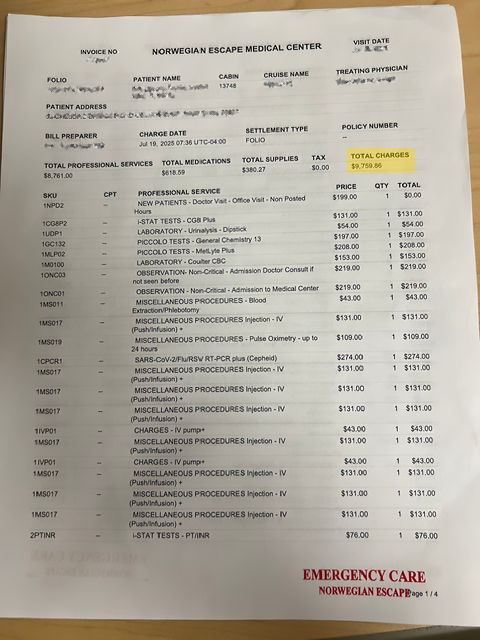
The passenger did not disclose exactly what had happened, but the invoice was marked as emergency care and included charges for a consultation, blood tests, respiratory testing, monitoring, IV treatment, medical supplies and medication.
The bill was charged to the passenger’s onboard account, highlighting how quickly the cost of treatment at sea can add up when several tests and treatments are required.
How Cruise Ship Medical Charges Work
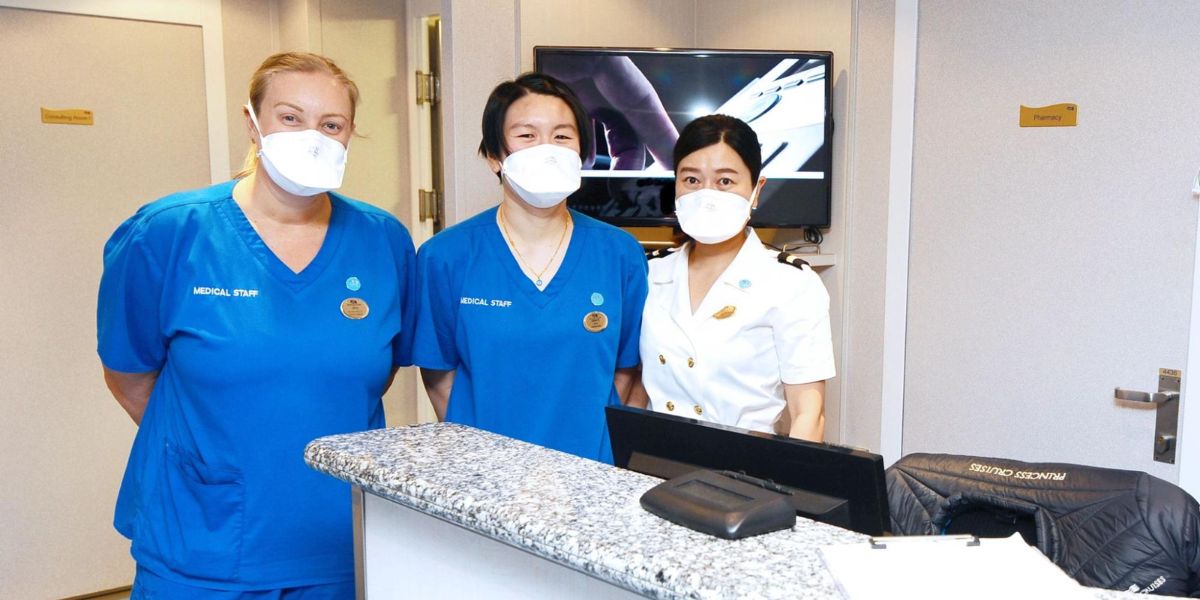
Cruise ships have onboard medical centres staffed by doctors and nurses, with emergency assistance available around the clock on major cruise lines.
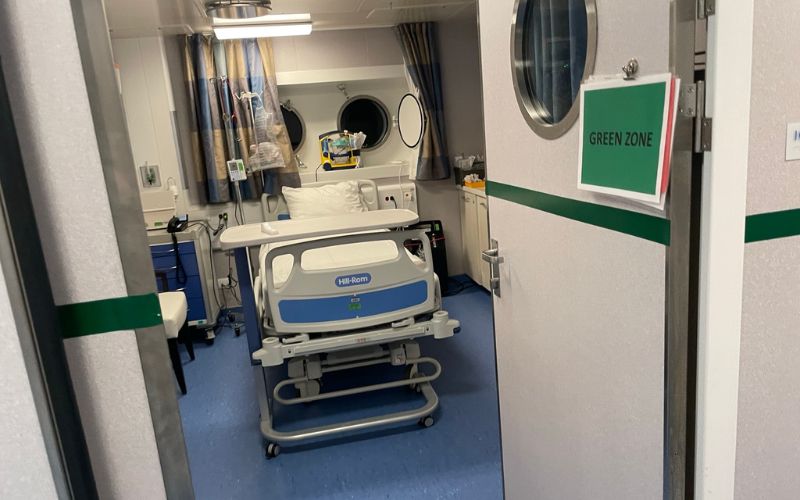
However, they aren’t the same as a full hospital on land. They’re designed to deal with routine illnesses and injuries, as well as stabilising passengers in more serious situations until further treatment can be arranged.
Medical care is normally charged separately from your cruise fare.
A consultation may carry one fee, with additional charges for things such as:
- Blood tests
- X-rays or other diagnostic tests
- Medication
- IV treatment
- Medical supplies
- Other procedures or treatment
There may also be higher charges if you need treatment outside the medical centre’s normal opening hours.
If your condition requires care beyond what the ship can provide, you may need to be taken to a hospital ashore or medically evacuated. Those costs can be significantly higher again.
You’ll Usually Have To Pay First
Having travel insurance doesn’t necessarily mean you can hand over your policy details at the medical centre and leave the insurer to deal with the bill.
Cruise lines commonly charge medical expenses to your onboard account first. You can then use your receipts and medical paperwork to make a claim through your insurer afterwards.
Norwegian Cruise Line, for example, says onboard medical fees are billed to the guest’s stateroom account and it doesn’t offer direct billing to insurance providers.
Other cruise lines operate in a similar way, so it’s important to understand that even with good travel insurance, you may still need to cover the cost initially.
Whether you’re reimbursed afterwards depends on your individual policy, including its medical limits, exclusions, excess and any requirements relating to pre-existing conditions.
For UK cruisers, it’s also important not to assume that access to the NHS at home means you’ll be covered for treatment onboard a cruise ship. Proper travel insurance with cruise cover remains essential.
How To Protect Yourself From A Huge Medical Bill
Nobody can guarantee that they won’t become ill or injured while cruising, but there are a few things you can do before you sail to reduce the financial risk.
First, make sure your travel insurance actually covers cruises. Don’t simply assume that a standard policy will provide everything you need.
Check the medical treatment limit, as well as cover for emergency evacuation and repatriation. Medical evacuation can be particularly expensive if you need to be transferred from the ship to a suitable hospital or transported home.
You should also declare any pre-existing medical conditions accurately. Failing to do so could cause problems if you later need to make a claim.
It’s worth checking the excess too, so you know how much of any medical bill you’ll need to pay yourself.

If you do receive treatment onboard, ask for an itemised bill and copies of any relevant medical records before you leave the ship. Keep receipts and proof of payment as well, as your insurer may ask for these when processing your claim.
And if anything on the bill looks wrong or you don’t understand a charge, ask about it while you’re still onboard rather than waiting until you get home.
The Bottom Line
Nobody books a cruise expecting to end up in the medical centre, and most passengers will hopefully never need it.
But if something does go wrong, treatment onboard can be expensive, particularly once tests, medication or emergency care are involved.
The most important thing is to have suitable travel insurance before you sail and understand how you’ll make a claim if you need treatment. You may still have to pay the cruise line first, so keep every invoice, receipt and medical record you’re given.
Hopefully you’ll never need any of it. But it’s much better to understand how the system works before you’re sitting in the medical centre staring at an unexpected bill.
TODAY’S BEST CRUISE DEALS!
Don’t miss these offers…
