
Titanic was just two days away from reaching New York when disaster struck. But how much of her famous maiden voyage had she actually completed?
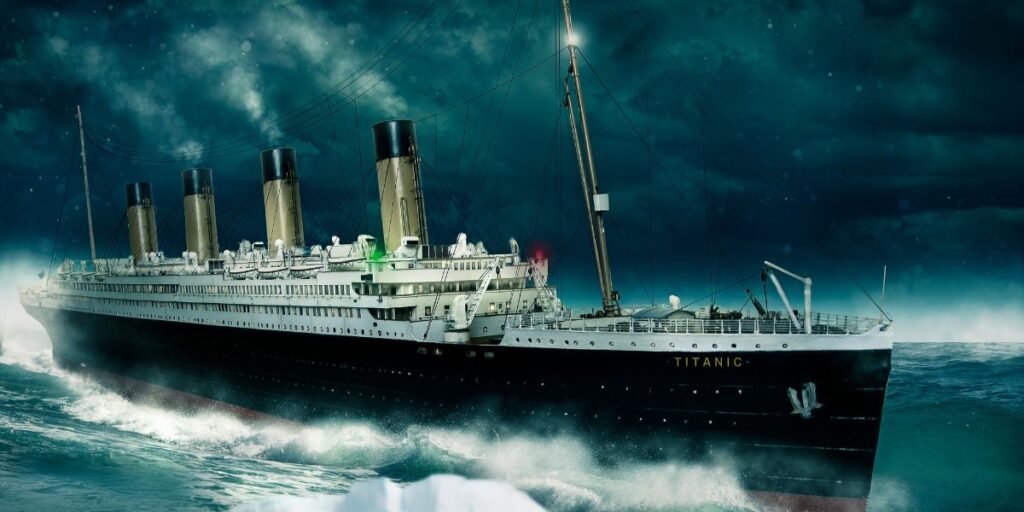
Most people know that Titanic sailed from Southampton and sank in the Atlantic. What fewer realise is that she stopped in France and Ireland first, picking up hundreds of passengers before setting off across the ocean.
Her route had been carefully planned, with a scheduled arrival in New York on 17th April 1912. But things went terribly wrong on the night of 14th April.
Titanic’s Original Route Across the Atlantic
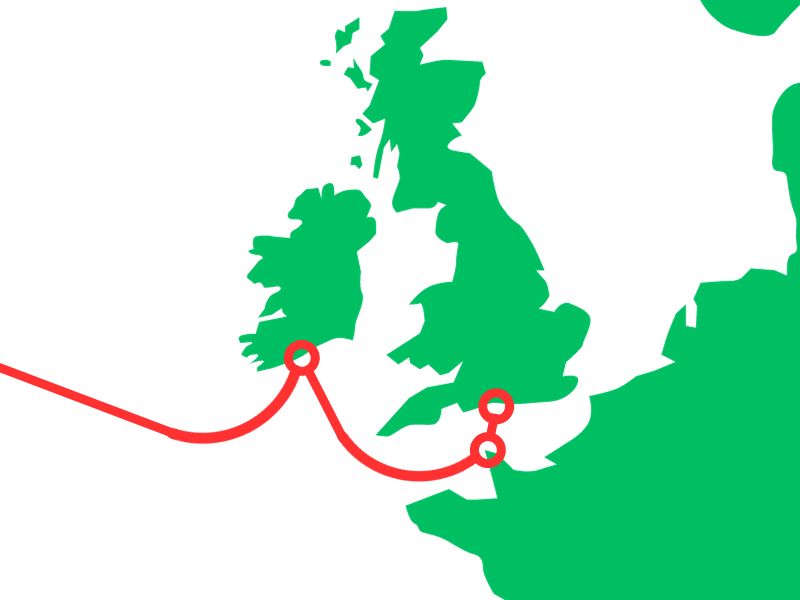
The original route of the Titanic on her maiden voyage saw her sail from Southampton to Cherbourg in France and then to Cobh in Ireland, before departing for New York. The Atlantic crossing from Ireland to New York would have covered approximately 2,890 nautical miles (3,325 miles), with additional distance travelled between Southampton, Cherbourg and Queenstown.
The ship’s first sailing was from Belfast but that was just to relocate to Southampton, where the official maiden voyage would depart. After calling at Cherbourg and Cobh, the ship undertook a four-leg journey to get across the Atlantic.
The Titanic’s Journey Across The Atlantic
- Sailing 55 nautical miles from the Queenstown waters of Ireland to Fastnet, an island in the Atlantic that’s home to the Fastnet Lighthouse
- Sailing a circle path from Fastnet to ‘The Corner’, a point in the Atlantic Ocean situated at 42°N, 47°W. This was the longest leg of the journey, with the Titanic sailing approximately 1,620 nautical miles
- A straight line course from The Corner to Nantucket Shoals, which would have been around 1,023 nautical miles
- A final straight line to the Ambrose Channel, which marks the entrance to New York harbour – around 193 nautical miles
It was between steps 2 and 3 that the ship sank – around 1,250 miles from her final destination of New York. You can see the spot on the map below.
The majority of Titanic’s paying passengers for the sailing boarded in Southampton, but the calls in Cherbourg and Cobh did see some passengers board and disembark.
Around two dozen passengers got off the ship in Cherbourg, only boarding the Titanic to cross the English Channel. The exact number is debated. 274 passengers came on board the ship here.
In Cobh, just 7 passengers disembarked – most were on the ship for the full sailing. Around 120 passengers boarded the ship there.
Both Cherbourg and Queenstown (Cobh) were tender ports, where passengers were ferried between the shore and Titanic. SS Nomadic and SS Traffic served Cherbourg, while PS Ireland and PS America were used at Queenstown.
Titanic’s Departure
The Titanic departed from Southampton on her maiden voyage, but she called at two ports before setting off on the last leg of her final sailing. Her final departure port was Queenstown (Cobh), from which she was sailing across the Atlantic Ocean.
Titanic departed Belfast on 2nd April 1912, following her sea trials, and reached Southampton late on 3rd April or in the early hours of 4th April. She remained there until her maiden voyage began on 10th April, taking on passengers, crew and supplies.

Titanic’s Destination
The Titanic was headed to New York City on her maiden voyage when she sank. She was due to sail Transatlantic voyages between Southampton and New York on a regular timetable, but never completed her first journey.
In 1912, New York was one of the world’s busiest ports, welcoming huge numbers of passengers and immigrants arriving from Europe. As a result, it was typically the destination port for most ships sailing across the Atlantic.

Map of Titanic’s Route
Here’s a map of the route that the Titanic took, showing the ports of call and the intended path of the ship towards New York:
Titanic Ports of Call
Here’s a look at the ports of call for the Titanic’s maiden voyage, including dates and times:
- Southampton – embarked on 10th April 1912 at around 12.15pm.
- Cherbourg – arrived on 10th April 1912 at around 6.35pm. Departed at around 8.10pm.
- Queenstown (Cobh) – arrived 11th April 1912 at around 11.30am. Departed at 1.30pm.
The ship was due to arrive in New York on 17th April 1912 but sank on 15th April.
The ports of call for the return journey were different – the ship was scheduled to sail from New York to Plymouth in Devon, before sailing down to Cherbourg in France and then returning to Southampton to complete the return leg.
How Long Titanic’s Route Was Meant to Take
Titanic was scheduled to take around seven calendar days to travel from Southampton to New York. She called at Cherbourg on 10th April and Queenstown on 11th April, before beginning the Atlantic crossing, with arrival in New York planned for 17th April.

The Titanic was not designed to be the fastest ship on the ocean. Indeed, the Mauretania and Lusitania that were sailing for rival cruise line Cunard were both much faster; and could complete the journey in under five days.
One popular myth is that Titanic’s captain was trying to break the record for the fastest Atlantic crossing. There’s no convincing evidence that this was the case, as Titanic was designed to prioritise luxury over speed.
However, the ship was travelling at high speed despite receiving warnings about ice in the area, which contributed to the disaster.
It was on the fifth day of the sailing overall – and the fourth day of the actual crossing of the Atlantic – that the ship sank. She departed Cobh on the 11th of April, began to sink on the night of the 14th of April, and fully sank in the early hours of the 15th of April.
How Far Titanic Was From Its Final Destination
Titanic was around 1,250 miles from its final destination of New York when it sank. The nearest land was Newfoundland, hundreds of miles away.

Titanic struck the iceberg at 11.40pm on 14th April 1912 and sank at approximately 2.20am the following morning, still around two days from her scheduled arrival in New York.
The fact that the ship was so remote at the time of her sinking was one of the major reasons there were so many casualties – the RMS Carpathia did manage to reach the site of the sinking and rescue those in lifeboats, but only by 4 am and even then that was with sailing at high speeds through risky waters.
Ships Still Take The Same Route As The Titanic
Some ships still take the same route as the Titanic. Many cruise ships sail Transatlantic voyages from Southampton to New York, with some calling at France and Ireland en route. Ships still cross the same general area of the North Atlantic, although their exact routes can vary depending on weather, sea conditions and other navigational factors.
Suggested read: How Long Is A Transatlantic Cruise?

A lot of modern Transatlantic sailings are more direct between Southampton and New York too, while others may call at the Azores – the Portuguese archipelago in the Atlantic. This is generally done just to break up the sailing so that guests aren’t having too many sea days in a row.
Modern ships are much better equipped to avoid icebergs, thanks to improved navigation technology, ice monitoring, weather forecasts and international safety procedures. While icebergs still pose a danger, ships have far more information available to help them avoid hazardous areas.
I attended a talk about how cruise ships navigate while I was onboard Fred. Olsen’s Bolette. The officer explained how the ship usually has six lookouts, who work in eight-hour shifts, two at a time. This is in addition to the modern computer technology that can detect icebergs.
Transatlantic cruises are very safe and many thousands of passengers sail on these cruises each year, whether as part of a repositioning cruise (where a cruise ship relocates for a season, often between the Caribbean in winter and Europe in the summer), or just as part of a regular Transatlantic cruise, often with Cunard.

Final Word
The Transatlantic route sailed by the Titanic is still used today by ships – although not always exactly the same in terms of ports of call. Passengers of modern Transatlantic cruises don’t need to worry about succumbing to the same fate as the Titanic though.
Modern navigation technology, ice monitoring and stricter maritime safety regulations have made transatlantic voyages much safer than they were in Titanic’s day.
Plus, even if there was an incident in the middle of the ocean, modern cruise ships are better equipped to deal with them, including having sufficient lifeboats.
So if you like the idea of a modern Transatlantic cruise, don’t be put off.
TODAY’S BEST CRUISE DEALS!
Don’t miss these offers…
