
How do you get a cruise ship that’s bigger than a skyscraper into the water without damaging it?
You might imagine some enormous machinery carefully lowering it into the sea. Or perhaps you’ve seen those incredible videos of ships sliding sideways into the water, creating a giant wave as they go.
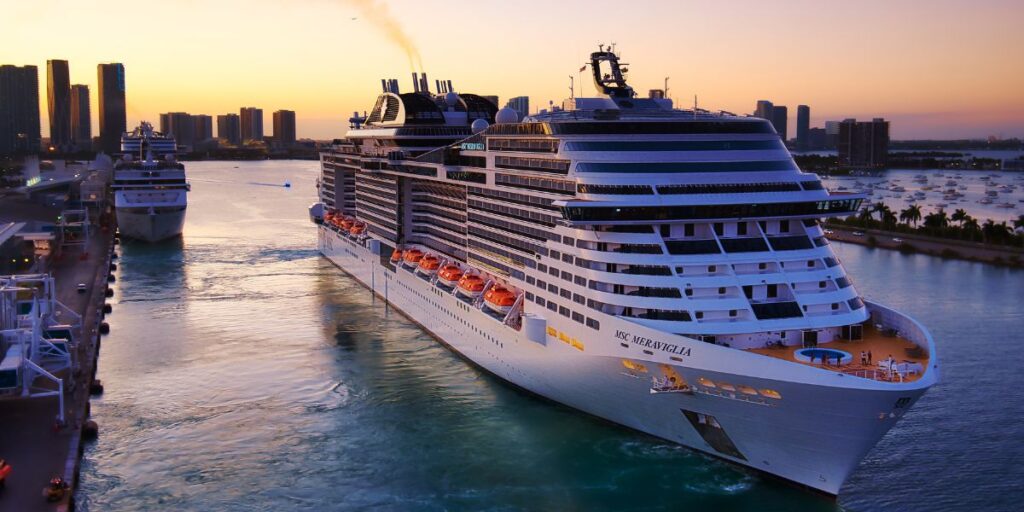
But modern cruise ships are launched in a very different way, and having watched Disney Destiny being floated out at the shipyard myself, I can tell you it’s quite a spectacle.
The cleverest part? The shipyard doesn’t actually need to lift the ship at all.
The Different Ways Ships Can Be Launched
There are four main ways that ships can be launched into the water. Two of those only really apply to smaller ships, though.
1. Mechanical Launching
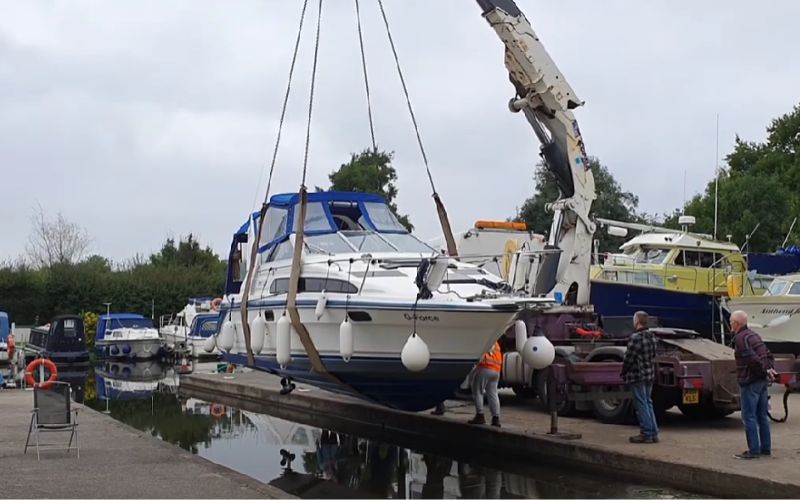
Mechanical launching involves using a crane to lift a boat or small ship, and then moving it into the water. Imagine trying to do this with a cruise ship!
2. Air Bag Launches
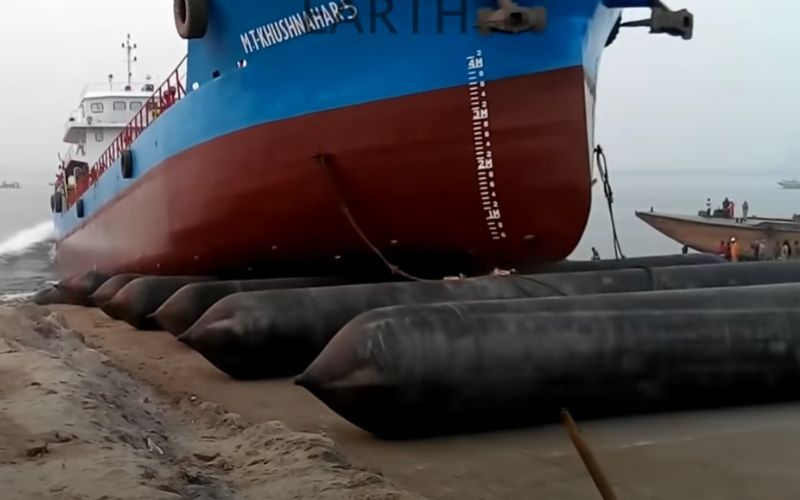
Some ships are launched using large inflatable airbags placed beneath the hull. These act like rollers, supporting the vessel as it moves gradually towards the water.
Neither method is practical for launching today’s enormous cruise ships. They’re simply too large and heavy, so shipyards use other techniques to get them safely into the water.
3. Gravitational Launching
Gravitational launching is a method used for large vessels, although it’s uncommon for today’s enormous cruise ships.
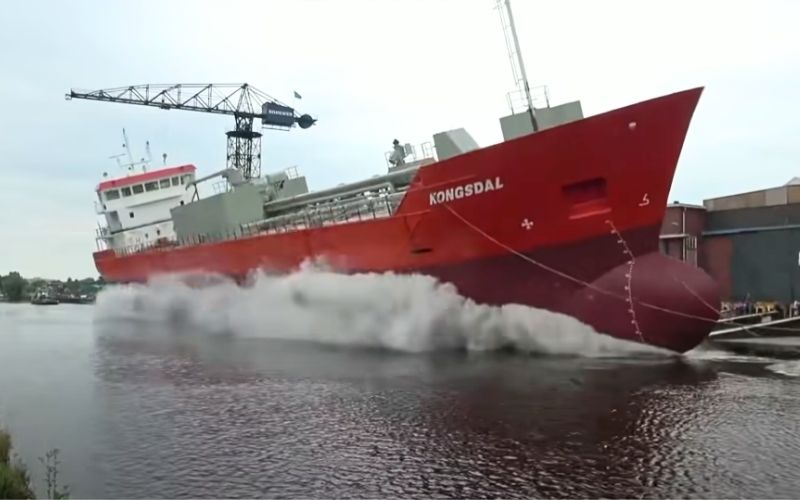
The ship is built on a specially designed slipway and then released, allowing gravity to carry it into the water.
Some ships slide into the water stern-first, while others are launched sideways. Sideways launches are particularly dramatic because the vessel can roll heavily as it hits the water before settling upright.
It’s an impressive sight, but it places considerable forces on the hull, which engineers must carefully account for.
It looks incredible in YouTube videos, though!
4. Floating Out
The fourth method is far less dramatic, but it’s by far the safest and smartest option for modern cruise ships.
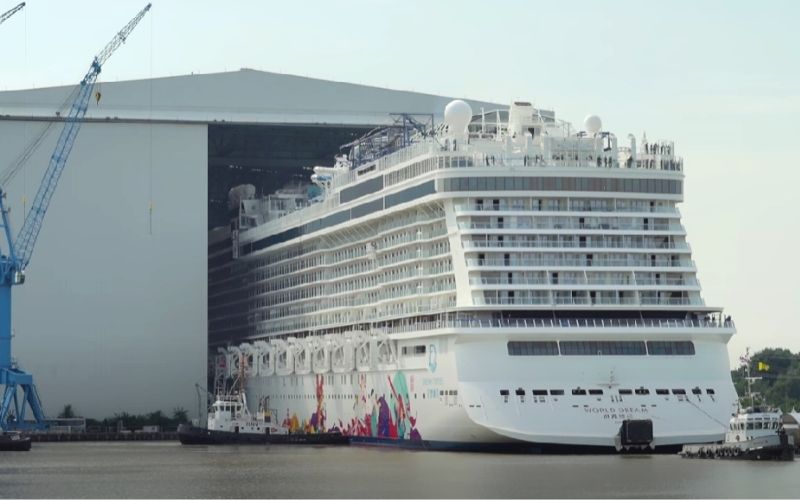
How Floating Out Works
Cruise ships are typically built in large dry docks, which may be open-air or enclosed. Once the ship is ready to float, water is gradually pumped into the dock until the vessel rises from its supports and can be moved out.
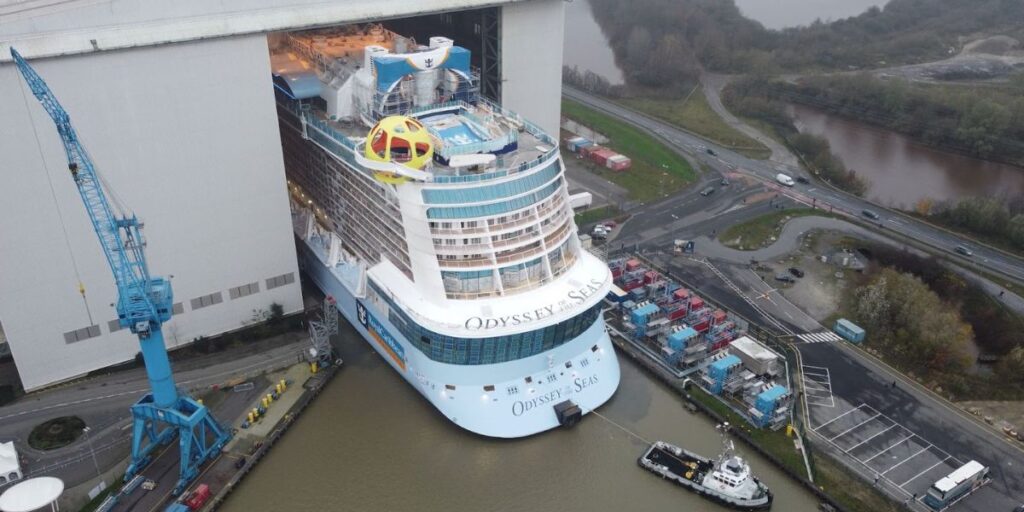
While the actual launching of the ship is therefore low on drama, it’s often accompanied by a lot of pomp – cruise ships are expensive and so cruise lines like to celebrate each stage of their building journey.
Here’s an example from when Disney Wish was floated out – it’s Disney, so of course there are multiple sets of fireworks:
I also attended the floating out of the Disney Destiny, which was super fun to be part of.
In terms of protecting the ship, floating out is much gentler than launching it down a slipway.
The dock is gradually flooded until the ship becomes buoyant and lifts away from the supports beneath it. There’s no dramatic impact with the water, although engineers still need to monitor everything carefully to ensure the ship remains stable throughout the process.
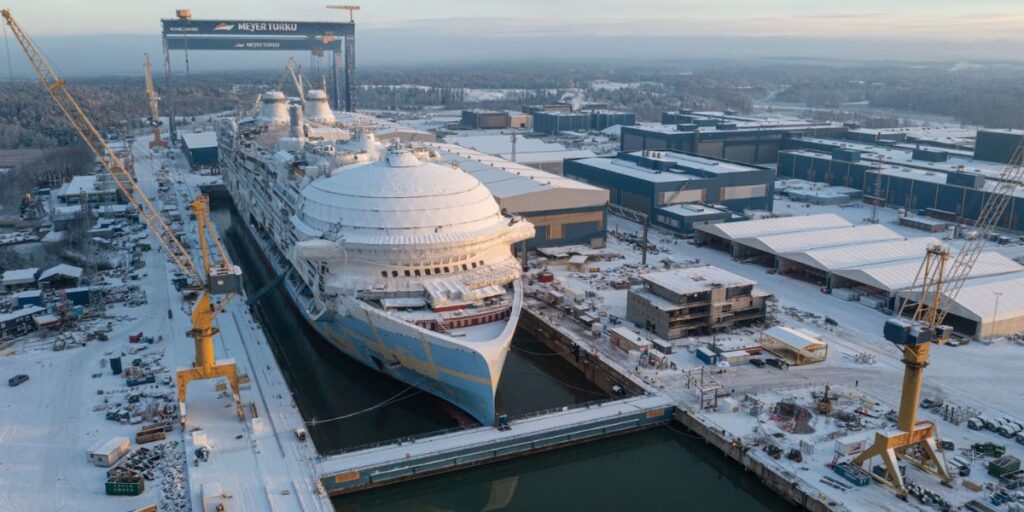
Obviously, for this type of launch to work, you need a lot of space, and so dry docks are limited to just a handful of shipyard locations around the world.
Here’s a look at the biggest ship in the world, Icon of the Seas, floating out for the first time. It involved 219 million litres of water, which took 9 hours to fill the dock.
Cruise Ship Float Outs, Step-by-Step
Here’s a quick run-down of how cruise ship float outs work.
- Cruise ships are built in a large dry dock, using support structures to make sure they stay upright. It’s always interesting to see photos of a cruise ship out of water – it doesn’t look right.
- Once the hull is sufficiently complete and watertight, the ship is ready to be floated out.
- The dock is flooded using seawater. This is a slow process that is often done overnight.
- Once the dock is flooded, the ship will begin to float.
- Once floating, the ship is carefully manoeuvred out of the building dock, often with the assistance of tugboats, and moved to an outfitting berth where construction can continue.
- Once the ship reaches its outfitting berth, it is securely moored so that construction can continue.
Construction will then carry on until the ship is almost ready for passengers. She’ll then be sent on sea trials while final fixtures are added.
TODAY’S BEST CRUISE DEALS!
Don’t miss these offers…
That’s the practical side of a float out, but there may be other ceremonial steps involved too. Again, this is seen as quite an important stage in a cruise ship’s life.
Depending on the shipyard and cruise line, the float-out may include speeches, music and other celebrations. Some shipyards also hold a Champagne ceremony, although the ship’s official naming ceremony usually takes place much later, closer to its entry into service.
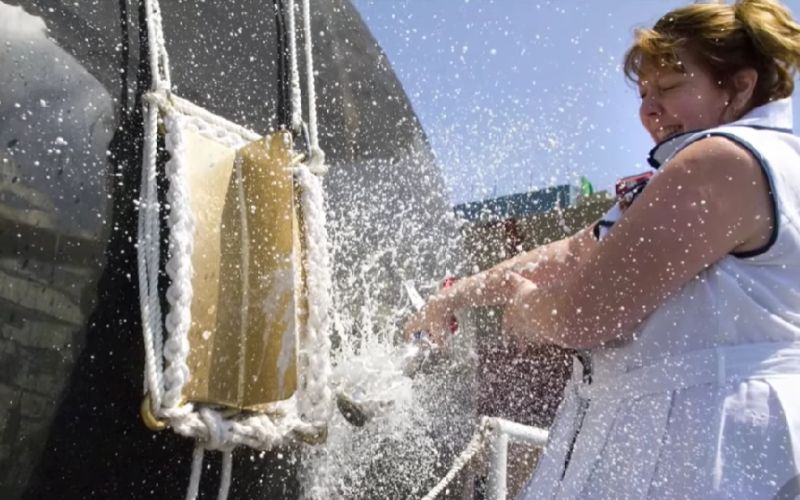
Depending on the ship and the stage of the build, the senior dignitaries may take in the float out from the dock at the side of the ship, or they may board and witness it from the current top deck.
Cruise Ships Are Often Finished Off in the Water
The initial steps of a cruise ship’s build don’t happen in the water. They happen in a dry dock, which has been drained. Once the exterior of the ship is complete and the ship can be floated, the dock will be flooded, the ship floated out, and construction will continue.
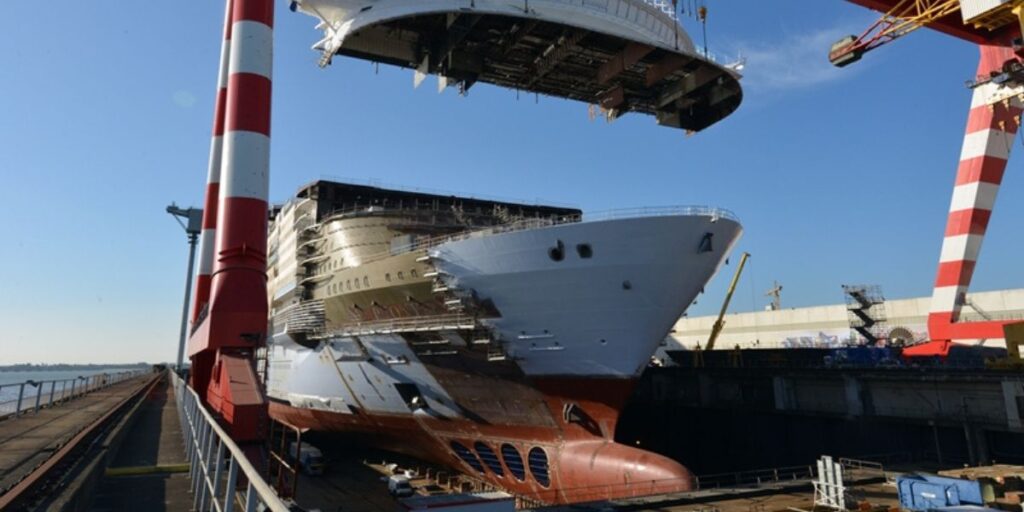
So, ships are partially built while they’re in the water. It may be that the ship needs to be moved to a new location to fit specialist features, or it just has to be outdoors to allow for larger works to be carried out on the ship.
Ships are usually floated out once their hulls are sufficiently complete and watertight, although plenty of work may already have taken place inside.
Moving the ship to an outfitting berth frees up the building dock for another project and allows work to continue on the interiors, equipment and other finishing touches.
Read more: How Long Does It Take To Build A Cruise Ship?
Once a ship has been floated out, it will stay in the water almost permanently. The only difference is when she may need to undergo extensive repairs or renovations, such as Royal Caribbean’s Amplification Program.
When this happens, she’ll return to the shipyard for another dry dock. She’ll be positioned above support structures, and the water will be slowly drained until the ship is sitting on dry land.
The repair work will be carried out, and then the dock will be flooded again, ready for the ship to float out and resume service.
Final Word
Launching a cruise ship might not look as dramatic as those old sideways launches you see online, but the modern float-out process is an incredible piece of engineering.
Instead of crashing into the water at high speed, these giant ships are carefully lifted by millions of litres of seawater until they naturally begin to float. It’s slower, safer, and far better for protecting ships that can cost well over a billion dollars to build.
And while the process itself is surprisingly calm, seeing a cruise ship float for the very first time is still a pretty amazing moment. It’s hard to believe something that enormous can simply rise out of the dock and sail away.
TODAY’S BEST CRUISE DEALS!
Don’t miss these offers…
