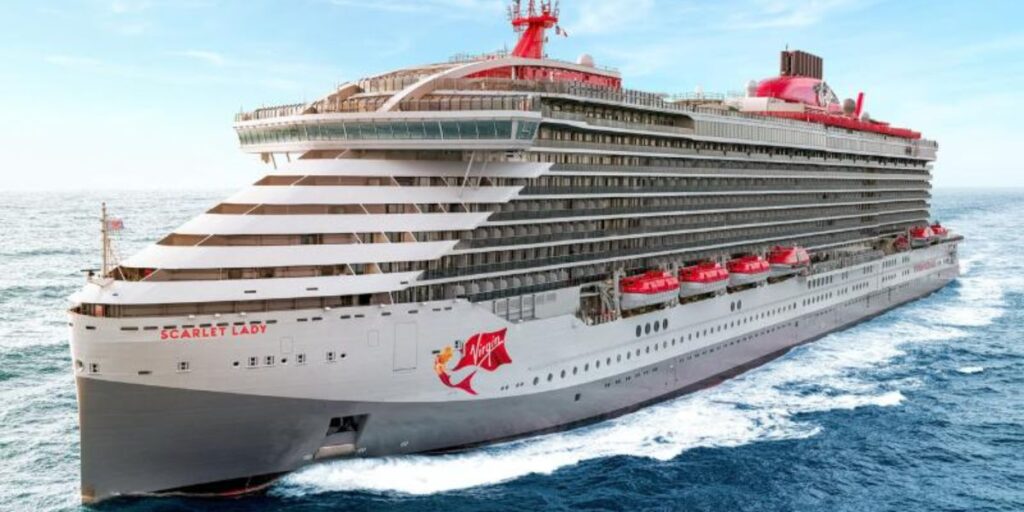
The owner of a Greek tour catamaran has filed a substantial claim against Virgin Voyages’ Scarlet Lady following a collision in Rhodes harbour on 30th September 2026, when the cruise ship broke her mooring lines during severe weather.
The claim, totalling at least €400,000, covers damage to the vessel and loss of revenue whilst the catamaran undergoes repairs and safety inspections.
Strong Winds Cause Scarlet Lady To Break Free In Rhodes
The incident occurred late on Wednesday evening, 30th September 2026, when Scarlet Lady was moored at Rhodes during what should have been an overnight stay.
The ship had originally been scheduled to depart the Greek island at 6:00 p.m. that evening, but the Port of Mykonos – the next destination on the vessel’s seven-night itinerary – had closed due to adverse weather conditions.
Powerful winds and swells buffeted the harbour throughout the evening, ultimately causing Scarlet Lady’s mooring lines to snap.
The 110,000-tonne cruise ship drifted briefly before making contact with the catamaran King of Rhodes and two smaller craft moored nearby.
At the time of the incident, port authorities and the cruise line reported no significant damage.
However, the catamaran’s owner has since come forward with claims of substantial harm to the vessel.
Extensive Damage Reported To King Of Rhodes Catamaran
According to local media reports, the owner of King of Rhodes filed documentation detailing multiple types of damage sustained during the collision.
The claim lists broken mooring caps, detached mooring pins, the complete loss of the vessel’s passenger boarding and disembarkation ladder, and destruction of the starboard platform that protects the catamaran’s propulsion system.
Beyond the visible damage, the owner has expressed serious concerns about potential hidden structural harm.
The catamaran’s hull, stern, mooring points, and propulsion system may have sustained damage that cannot be assessed without a comprehensive technical inspection.
To fully determine the extent of any such damage, King of Rhodes must be lifted from the water and examined by qualified marine technicians and naval architects.
This process requires specialist equipment and facilities, adding both time and expense to the situation.
Loss Of Revenue Compounds Financial Impact
The damage and subsequent need for inspection means King of Rhodes cannot currently operate its regular tourist sailing schedule.
The catamaran provides daily excursion services as part of the Sea Dreams fleet, carrying passengers between Rhodes, Symi, and Marmaris.
According to the company’s website, King of Rhodes is described as “a modern, closed type vessel” equipped with air conditioning and a snack bar.
The catamaran has a passenger capacity of 338 guests and can reach speeds of 33 knots (38 miles per hour).

The €400,000 claim – equivalent to roughly $448,000 USD – represents the owner’s estimate of both immediate repair costs and lost revenue during the inspection and repair period.
However, this figure may change substantially once technicians complete their assessment and the full extent of damage becomes clear.
The owner may also need to charter a replacement vessel to fulfil existing contract obligations for tourist excursions, which would further increase the financial burden.
Peak tourist season in the Greek islands represents critical income for such operators, making any interruption to service particularly costly.
Legal Action Filed To Prevent Scarlet Lady’s Departure
Following the collision, the catamaran’s owner moved quickly to file a legal claim with Greek authorities.
The application requested that Scarlet Lady be seized and prevented from leaving Rhodes on Thursday, 1st October, whilst also calling for a full investigation into the circumstances surrounding the incident.
The urgency of the filing stems from jurisdictional concerns.
Scarlet Lady is registered in the Bahamas and operates itineraries across multiple countries and regions.
The complaint alleges that if the ship had departed Greece without a formal claim being lodged, pursuing compensation would become significantly more complicated and might involve navigating foreign legal systems.
Greek maritime law permits vessel detention in cases where substantial claims are filed against foreign-flagged ships, providing a mechanism for local businesses to seek redress before a vessel leaves national waters.
Insurance Guarantee Allows Virgin Voyages Ship To Sail
Despite the seizure application, Scarlet Lady was permitted to depart Rhodes at 5:00 p.m. on 1st October as originally scheduled.
The Oslo-based marine insurance company Skuld delivered a “letter of guarantee” to Greek authorities that satisfied the legal requirements for the ship’s release.
Skuld, which maintains an office in Piraeus, Greece, as well as numerous other locations worldwide, provided assurance that the claim would be honoured if investigations determine Scarlet Lady was at fault for the collision.
This type of financial guarantee is standard practice in maritime incidents, allowing commerce to continue whilst legal proceedings unfold.
The letter of guarantee effectively places the insurance company on the hook for any damages awarded through the Greek court system, eliminating the need to physically detain the cruise ship.
This arrangement benefits all parties – the catamaran owner receives financial security, whilst Virgin Voyages can continue operating its published itinerary.
Court Proceedings Scheduled For February 2027
The complaint against Scarlet Lady will be formally discussed and reviewed by a local Greek court on 23rd February 2027.
This hearing will examine the evidence surrounding the incident, including weather conditions, proper mooring procedures, and whether appropriate precautions were taken given the forecasted severe weather.
Maritime lawyers will likely scrutinise whether Scarlet Lady’s crew followed established protocols for securing a vessel during adverse weather warnings.
Questions may also arise about whether the ship should have departed Rhodes earlier or sought alternative shelter, given that port closures were anticipated at Mykonos.
The investigation will need to establish causation – determining whether the mooring line failures resulted from inadequate seamanship, defective equipment, or simply weather conditions beyond reasonable control.
This distinction will prove critical in determining liability and the ultimate resolution of the claim.
Virgin Voyages Maintains Operational Focus Amid Legal Challenge
Virgin Voyages has not issued a public statement regarding the incident or the subsequent legal claim.
Cruise Hive reached out to the cruise line for comment but had not received a response by the time of publication.
The incident represents an unusual legal challenge for Virgin Voyages, the boutique cruise line founded by Sir Richard Branson’s Virgin Group.
Scarlet Lady, the company’s first ship, entered service in 2021 and has become known for its adults-only concept and contemporary approach to cruising.
The vessel measures 110,000 gross tonnes and can accommodate approximately 2,770 passengers in 1,330 cabins.
Built by Fincantieri at the Sestri Ponente shipyard in Italy, Scarlet Lady features distinctive red accents and a design philosophy focused on millennials and younger cruisers seeking an alternative to traditional cruise experiences.
Virgin Voyages operates four ships in total, with Scarlet Lady joined by sister vessels Valiant Lady, Resilient Lady, and Brilliant Lady.
The fleet primarily serves Mediterranean and Caribbean itineraries, with occasional transatlantic repositioning voyages.
Weather-Related Incidents Highlight Mediterranean Autumn Challenges
The collision in Rhodes harbour underscores the challenges cruise ships face when operating in the Mediterranean during autumn months, when weather patterns can shift rapidly and dramatically.
The region experiences increasing wind speeds and wave heights as summer transitions to winter, occasionally catching vessels and port facilities unprepared.
Greek islands, in particular, are susceptible to the Meltemi winds – strong, dry northerly winds that can exceed 40 knots and create hazardous conditions in harbours and anchorages.
These winds typically peak during summer but can occur with little warning well into October.
Port authorities across the Mediterranean have developed protocols for severe weather events, including vessel detention, additional mooring requirements, and port closures when conditions exceed safe operating parameters.
The closure of Mykonos port on 30th September demonstrates these precautionary measures in action.
For cruise lines, weather-related itinerary changes remain one of the industry’s most persistent operational challenges.
Ships must balance passenger expectations for published itineraries against the paramount concern for safety, occasionally resulting in extended port stays or cancelled calls when conditions deteriorate unexpectedly.
NEW DEALS JUST RELEASED!
Don’t miss the latest Virgin Voyages offers…