
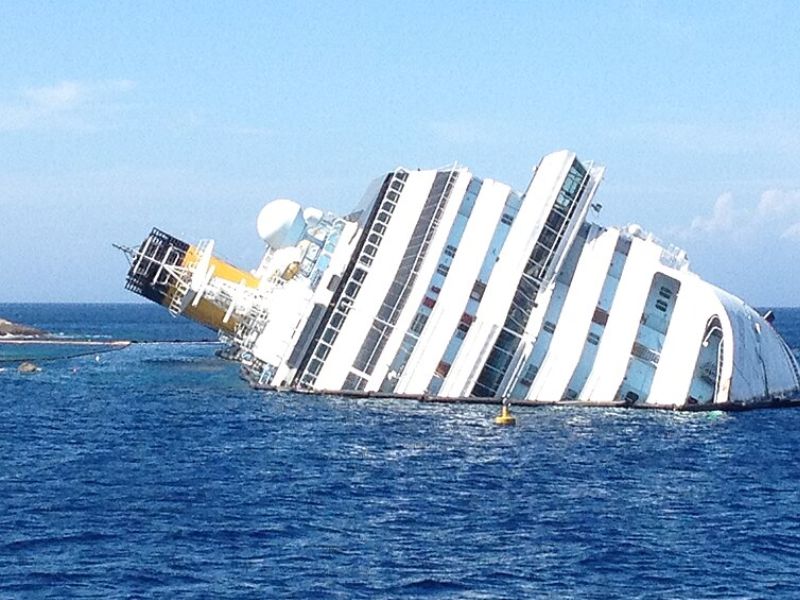
Costa Concordia didn’t sink to the bottom of the sea. What happened to the ship afterwards was almost as extraordinary as the disaster itself.

The enormous ship ran aground off the coast of Italy in 2012, in a tragedy that shocked the cruise industry and dominated headlines around the world. Incidents like this are extremely rare today, which is exactly why the story captured so much attention.
But even after spending around $2 billion to recover and dismantle the wreck, Costa Concordia would never sail again.
The Ship Is No More…
The Costa Concordia no longer exists – it has been dismantled for scrap. It lay off the coast of Giglio for over two years after the disaster, before it was recovered and towed to the port of Genoa where it was dismantled.
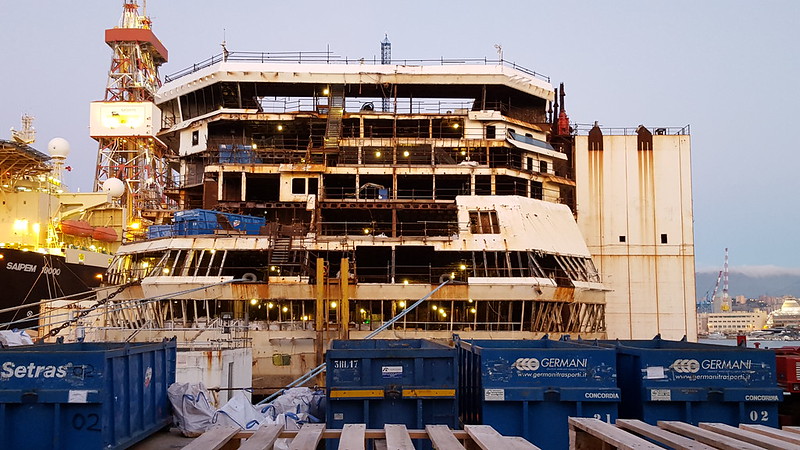
The salvage and dismantling of Costa Concordia is estimated to have cost around $2 billion, more than three times the ship’s original construction cost.
The scrap metal recovered was worth only a fraction of the salvage costs. Around 90% of the ship’s materials were recycled, including more than 53,000 tonnes of material.
Costa Concordia was declared beyond economical repair and never returned to service. Costa Diadema joined the fleet in 2014, although plans for the new ship had already been announced before the disaster.
Costa Concordia Sinking & Salvage Timeline
- 13 January 2012 – Costa Concordia runs aground at around 9.45 pm and begins to take on water.
- 14 January 2012 – The last survivors escape the ship.
- March 2012 – The fuel is removed from the ship by salvage company Smit International.
- 17 September 2013 – The ship is brought into a vertical position through a process of parbuckling.
- 14 July 2014 – The operation to refloat the ship begins in preparation for towing.
- 23 July 2014 – The ship begins its towing journey, travelling at just 2 knots (equivalent of 2.3 MPH).
- 27 July 2014 – The ship reaches Genoa port and dismantling begins.
- 11 May 2015 – After the initial dismantling is complete, the ship is towed to the Superbacino dock in Genoa where the upper decks will be removed.
- August 2016 – The last of the sponsons are removed from the ship.
- 1 September 2016 – The ship is taken into drydock for the final stages of dismantling.
- 7 July 2017 – The dismantling of the ship is finally completed.
- May 2018 – Remedial work was completed at the site of the initial salvage operation, to clean the ocean floor and remove the platform used in the parbuckling process.
To briefly explain the parbuckling process – firstly, the funnel is removed from the ship, and then a platform is built underneath the water to support the ship once it is righted.
The next step is to attach steel sponsons to the side of the ship above the water, and then partially fill these with water. The water acts as additional weight so that, with the use of cables, the ship can be pulled upright to sit on the support platform.
Once that’s done, sponsons are added to the previously submerged side of the ship to even it out, and are then emptied of water when the time comes to refloat the ship.
As for Those Onboard…
All of the people who died on the Costa Concordia were recovered, although it wasn’t a fast process – the last body was only recovered in November 2014, almost three years after the ship ran aground.
The last person to be found was Indian waiter Russel Rebello. He was discovered during the dismantling of the ship, after it had been transported to Genoa.
Prior to this, one Italian passenger had been missing until October 2013, when human remains were discovered. DNA testing showed that those remains belonged to Maria Grazia Trecarichi, and that Rebello was still unaccounted for.
Read more: How They Found All The Bodies On The Costa Concordia
Final Word
With any cruise ship sinking incidents such as the Costa Concordia disaster, the priority is always the people onboard, and the loss of life is the real tragedy. But it is also sad to lose a ship, one that thousands of people helped to build and hundreds of crew called their home for months on end.
The scrapping of the Costa Concordia is not the headline – the 32 people who died are those who deserve our thoughts. However, the fact that such a major cruise ship ended up as scrap metal, worth just a fraction of her original construction cost, is a real shame too.
